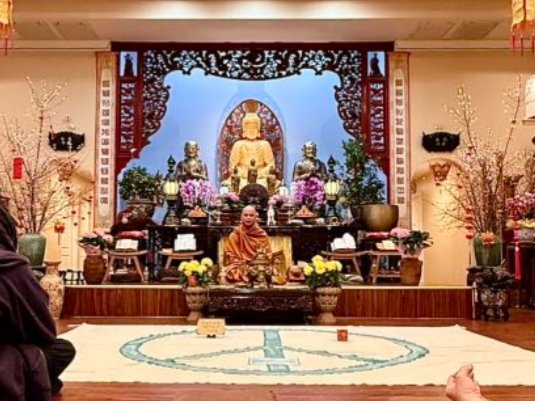
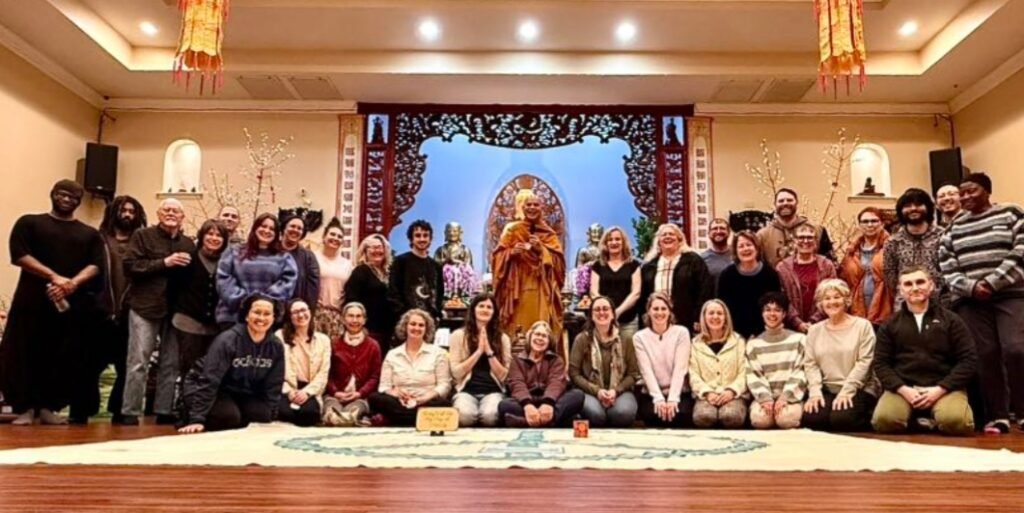
On the evening of Feb 11th, a beautiful gathering of people showed up at our temple to meditate in solidarity with the Venerable Bhante Paññakara’s Walk For Peace – Loving Kindness Meditation in DC.
As I watched our Buddha Hall fill up with people dedicated to spreading peace and unity, and to being a part of an inspiring movement, I was filled with a sense of joy.
We met and greeted each other informally, then once everyone had settled into their seats, on cousins or benches, we slid into a brief introduction as to the far reaching, global impact of this 2,300 mile walk and its mission, and how so many have joined in solidarity with the WFP monks, people from all faiths and traditions, as well as atheists and agnostics. Total inclusion.
The meditative part of the evening opened with the reading of the Buddha’s teaching on Loving Kindness, the Karaniya Metta Sutra, which invites our hearts and minds into a place that seeks only good, and of unconditional Loving-kindness for all living beings, no matter how distant, no matter how small, without judgement. With our minds quieted into a space of openness by these verses, a guided meditation followed. Its guidance brought our focus inward, going deeper and deeper, letting go of all external distractions, until we could reach into our own unconditioned True Nature of Stillness, Compassion, and Peace. Once reached, we were invited to embrace it and to spread it outward first to our own conditioned identity, then, step by step, out into the whole world and the entire universe, wishing it peace.
Thay Thanh, the Dharma Master for the English-speaking Sangha at our temple, then spoke to us on various meanings of the word “peace” and how the meaning might change in different situations. For Gaza, peace would be the end of war. For someone starving, peace would be food to eat. For someone experiencing a domestic feud, peace would be getting out of the house. But he reminded us that these ideas of peace, although true indeed for the moment, are circumstantial. In Buddhism, however, peace is, and must be, internal for it to be true. It cannot come from external conditions. With the cultivation of this inner peace, all the conditions of the external world can be met with less suffering. In closing, he reassured us that the recognition of reality as-it-is without judgement, the understanding of the true nature of impermanence, and the recognition of our own true nature of unconditional peace, are the key to inner peace.
We ended the evening by handing out tokens of the Walk For Peace, sharing our merit with all beings, and having a photo shoot. Thank you to all who gathered. And remember: “Today is going to be my peaceful day.” Say it with a sense of commitment.